Franklin Fastener
  • Competencies
    • Metal Stamping
    • Fourslide Stamping
    • Wire Forming
    • Welding and Assembly
    • Product Finishing
  • Engineering
    • Rapid Prototyping
    • Design
    • Tooling
  • Products
    • Custom Products
    • Plain and Coated Clamps
    • Frame and J-Clips
    • Cushioned Clamps
    • Engineered Solutions
  • Industries
    • Automotive
    • Heavy Truck
    • Engines
    • Military
  • Resources
    • Testimonials
    • FAQ
    • Blog
  • About
    • Accreditations
    • Areas We Serve
    • Supplier Requirements
  • Contact
  • Menu Menu
  • Link to LinkedIn
  • Link to Facebook

Military Clamps and Clips: Meeting MIL‑SPEC Standards

When it comes to defense applications, every component matters, including the clamps and clips that hold systems together. Whether securing fuel lines, electrical harnesses, or sensitive communications hardware, military clamps are critical for mission success. Unlike standard fasteners, these components must meet rigorous MIL‑SPEC (military specification) standards for performance, durability, and safety.
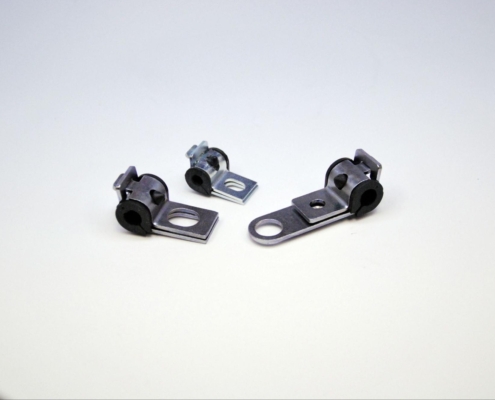
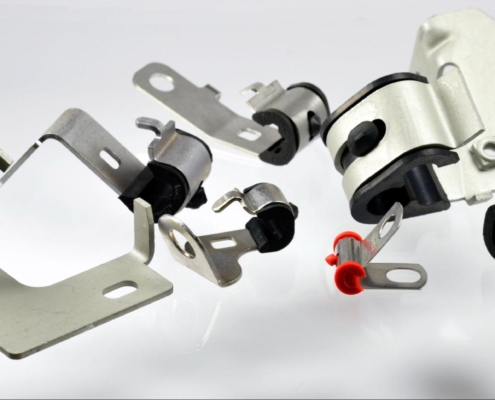
This guide walks through what makes a clamp MIL‑SPEC compliant, how they’re used in defense systems, and what to look for when selecting or specifying parts for your next contract.

What Makes a Clamp “Military-Grade”?

To qualify for military use, clamps and clips must comply with one or more MIL‑SPEC standards that define performance, materials, coatings, and documentation. These standards ensure the fasteners function reliably in harsh environments, from submarines to combat vehicles.

Common MIL‑SPEC Standards for Clamps and Clips

  • MIL‑DTL‑85052: This specification covers cushion clamps used to secure tubing, wiring, and cable assemblies. It outlines dimensional tolerances, vibration resistance, and environmental durability.
  • MIL‑STD‑889: Focuses on preventing galvanic corrosion between dissimilar metals, which is critical for clamp material compatibility.
  • MS21919 and MS21333: Cover common designs for cushioned and non-cushioned clamps used throughout military aircraft and ground systems.
  • MIL‑STD‑810: While not clamp-specific, this broader environmental standard tests products against shock, vibration, moisture, and temperature extremes.

Working with these standards ensures parts won’t degrade under pressure, and that your project won’t fail compliance audits.

Where Military Clamps Are Used in Defense Systems

Military clamps serve far more than a simple support function. In mission-critical environments, they protect the integrity of core systems. Their failure can result in electrical shorts, fuel leaks, or system downtime, all of which pose safety risks and cost contractors time and money.

  • Wire Harnessing and Electrical Systems: Wiring for navigation, communication, and control systems must be securely fastened and protected from abrasion, vibration, and EMI (electromagnetic interference). Military clamps with built-in isolators or EMI shielding help ensure signal integrity and physical protection.
  • Fuel and Hydraulic Lines: Clamps that secure fuel lines or hydraulic hoses in vehicles or aircraft must withstand heat, vibration, and fluid exposure. MIL‑SPEC cushioned clamps are often required to prevent rubbing, fatigue, or burst failures.
  • Avionics and Electronics: Sensitive electronics demand precision mounting solutions. Non-conductive clamps or those with EMI-resistant coatings are vital for preventing signal interference and ensuring reliability in avionics enclosures.
  • Armor and Tactical Equipment: Even personal equipment, from comms gear to battery packs, relies on specialized clips and clamps to secure components under rugged use.

Key Materials and Coatings for Military-Grade Durability

Material selection is one of the most important aspects of specifying military clamps. Choosing the wrong base metal or coating can result in corrosion, structural failure, or incompatibility with adjacent materials.

Stainless Steel

304 and 316 stainless steel are commonly used for military clamps due to their corrosion resistance and strength. 316 is often preferred in saltwater or high-humidity environments.

  • Use Cases: Naval systems, exposed vehicle lines, aircraft interiors

Aluminum

Aluminum clamps are valued for their light weight, but must be properly coated to prevent corrosion, especially when mounted near other metals.

  • Use Cases: Aircraft and lightweight vehicle platforms

Non-Metallic Options

High-performance plastics like polyamide or PTFE are used in EMI-sensitive areas or to avoid galvanic corrosion. These materials are also ideal when electrical insulation is required.

  • Use Cases: Communication systems, electronics enclosures

Protective Coatings

  • Zinc-Nickel Plating: Enhances corrosion resistance and is often used in high-vibration areas.
  • Cadmium Plating: Offers excellent corrosion protection and conductivity, but use is restricted due to environmental concerns.
  • Powder Coating / Nylon Coating: Adds abrasion and fluid resistance, often used in areas with mechanical wear or chemical exposure.

Defense contractors don’t have room for fastener failures. Franklin Fastener builds engineered military clamps that meet the strictest MIL‑SPEC standards and perform under pressure. Check out more about our products.

Engineered Military Fasteners

Testing and Compliance Procedures

Before a clamp is approved for military use, it must pass specific tests to make sure it meets all mechanical and environmental requirements. This is where MIL‑SPEC documentation plays a key role in both sourcing and inspection.

Common Test Procedures for Military Clamps

  • Vibration Testing: Simulates conditions found in aircraft and ground vehicles. Clamps must maintain hold and cushioning performance.
  • Salt Spray Testing: Measures corrosion resistance. Coatings and materials are evaluated for rust, pitting, and finish degradation.
  • Thermal Cycling: Tests expansion, contraction, and material stability under extreme temperature changes.
  • Tensile/Shear Strength: Evaluates how much load the clamp can handle before failure, especially critical for fluid and pressure lines.
  • Electrical Isolation or Conductivity: Depending on application, clamps are tested for EMI shielding or insulation performance.

Documentation Required

  • Certificates of Conformance (CoC): Verify that parts meet specified MIL‑SPEC or drawing requirements.
  • First Article Inspection (FAI): Confirms that initial production matches all spec dimensions and tolerances.
  • Lot Traceability: Required for many contracts to track materials, processes, and inspections for every shipment.

Pitfalls to Avoid in Military Clamp Sourcing

Defense sourcing teams are often tasked with tight deadlines, budget constraints, and multi-level compliance oversight. Mistakes in clamp or clip selection can cause major setbacks.

  • Misunderstanding Coating Compatibility: Clamps might pass material specs but fail due to galvanic mismatch with adjacent parts. MIL‑STD‑889 must always be considered when pairing dissimilar metals.
  • Using Commercial-Off-the-Shelf Parts: Not all COTS clamps meet military tolerances or traceability requirements. Unless explicitly allowed, always confirm parts are qualified to military specifications.
  • Incomplete Documentation: Failure to provide CoCs, FAI reports, or material certs can delay inspections or shipments. Working with a manufacturer experienced in military contracts helps avoid these issues.

Why Work With a Clamp Manufacturer That Knows Defense

At Franklin Fastener, we’ve spent decades building rugged, compliant, and performance-focused military clamps. We know what it takes to meet strict tolerance and testing standards, and how to streamline the sourcing process for engineers and procurement teams. We offer:

  • MIL‑SPEC clamp design and manufacturing expertise
  • Material guidance for your environmental and EMI needs
  • Coating recommendations based on corrosion resistance and galvanic compatibility
  • Prototyping and rapid production options
  • Complete documentation for audits and compliance

Whether you’re building for air, land, or sea, our clamps are made to perform, backed by deep knowledge of military standards and real-world requirements.

Secure Your Systems With Clamps That Go Beyond Spec By Partnering With Franklin Fastener

MIL‑SPEC compliance isn’t a box to check; it’s a performance standard your systems depend on. Franklin Fastener delivers military clamps that meet the environmental, mechanical, and documentation requirements you need to move forward with confidence. If you’re sourcing fasteners for a defense program, let’s make sure they’re built to last and ready to deploy. Connect with our expert team today.

Share This Post

  • Share on Facebook
  • Share on X
  • Share on WhatsApp
  • Share on Pinterest
  • Share on LinkedIn
  • Share on Tumblr
  • Share on Vk
  • Share on Reddit
  • Share by Mail

More Like This

Innovations in Engineered Clamp and Clip Manufacturing: What Engineers Need to Know

Innovations in Engineered Clamp and Clip Manufacturing: What Engineers Need to Know

Clamps
https://franklinfastener.com/wp-content/uploads/2025/09/image1-3.jpg 1339 1999 Abstrakt Marketing /wp-content/uploads/2022/12/fastener-logo1-01.png Abstrakt Marketing2025-09-18 08:34:262026-05-24 10:50:35Innovations in Engineered Clamp and Clip Manufacturing: What Engineers Need to Know
Corrosion‑Resistant Clips and Clamps for Heavy Truck & Off‑Road Applications

Corrosion‑Resistant Clamps and Clips for Heavy Truck & Off‑Road Applications

Clamps, Heavy Truck
https://franklinfastener.com/wp-content/uploads/2025/09/image1-2.jpg 966 1999 Abstrakt Marketing /wp-content/uploads/2022/12/fastener-logo1-01.png Abstrakt Marketing2025-09-18 08:26:442026-05-24 10:50:36Corrosion‑Resistant Clamps and Clips for Heavy Truck & Off‑Road Applications
When One Size Doesn’t Fit All – How to Know You Need a Custom Clamp

When One Size Doesn’t Fit All: How to Know When You Need Custom Clamps

Clamps, Custom Products
https://franklinfastener.com/wp-content/uploads/2025/09/image1-1.jpg 1339 1999 Abstrakt Marketing /wp-content/uploads/2022/12/fastener-logo1-01.png Abstrakt Marketing2025-09-18 08:21:502026-05-24 10:50:36When One Size Doesn’t Fit All: How to Know When You Need Custom Clamps
Image1

Why Material Matters: Comparing Steel, Aluminum, and Coated Clamps

Clamps
https://franklinfastener.com/wp-content/uploads/2025/09/image1.jpg 1250 2000 Abstrakt Marketing /wp-content/uploads/2022/12/fastener-logo1-01.png Abstrakt Marketing2025-09-18 08:07:172026-05-24 10:50:36Why Material Matters: Comparing Steel, Aluminum, and Coated Clamps

Clamp and Clip Failures: What Fastener Procurement Teams Overlook During Sourcing

Clamps, Fastening
https://franklinfastener.com/wp-content/uploads/2025/08/applications007-2.jpg 1250 2000 Abstrakt Marketing /wp-content/uploads/2022/12/fastener-logo1-01.png Abstrakt Marketing2025-08-12 11:23:312026-05-24 10:50:36Clamp and Clip Failures: What Fastener Procurement Teams Overlook During Sourcing
Previous Previous Previous Next Next Next

Categories

  • Clamps
  • Competencies
  • Custom Products
  • Engineering
  • Fastening
  • Heavy Truck
  • Metal Stamping
  • Products
  • Uncategorized
  • Welding and Assembly
  • Wire Forming

Contact Us

"*" indicates required fields

This field is for validation purposes and should be left unchanged.

About Us

Franklin Fastener is an industry-leading provider of engineered metal products. From concept to completion, our experts provide our clients with the highest service levels.

What We Do

Competencies

Engineering

Products

Industries

Documentation

Terms of Sale

Terms of Purchase

Catalog

Supplier Requirements

Contact Us

12701 Beech Daly, Redford Charter Twp, MI 48239

313-537-8900

websales@franklinfastener.com

Accreditations

Website by Abstrakt Marketing Group © 2023
  • Sitemap
  • Privacy Policy
Link to: Innovations in Engineered Clamp and Clip Manufacturing: What Engineers Need to Know Link to: Innovations in Engineered Clamp and Clip Manufacturing: What Engineers Need to Know Innovations in Engineered Clamp and Clip Manufacturing: What Engineers Need...Innovations in Engineered Clamp and Clip Manufacturing: What Engineers Need to Know Link to: The Power of the Damper Assembly: Solutions for Automotive and Heavy Trucking Link to: The Power of the Damper Assembly: Solutions for Automotive and Heavy Trucking The Power of the Damper Assembly: Solutions for Automotive and Heavy Trucki...
Scroll to top Scroll to top Scroll to top

This site uses cookies. By continuing to browse the site, you are agreeing to our use of cookies.

AcceptLearn more

Cookie and Privacy Settings


How we use cookies

We may request cookies to be set on your device. We use cookies to let us know when you visit our websites, how you interact with us, to enrich your user experience, and to customize your relationship with our website.

Click on the different category headings to find out more. You can also change some of your preferences. Note that blocking some types of cookies may impact your experience on our websites and the services we are able to offer.

Essential Website Cookies

These cookies are strictly necessary to provide you with services available through our website and to use some of its features.

Because these cookies are strictly necessary to deliver the website, refusing them will have impact how our site functions. You always can block or delete cookies by changing your browser settings and force blocking all cookies on this website. But this will always prompt you to accept/refuse cookies when revisiting our site.

We fully respect if you want to refuse cookies but to avoid asking you again and again kindly allow us to store a cookie for that. You are free to opt out any time or opt in for other cookies to get a better experience. If you refuse cookies we will remove all set cookies in our domain.

We provide you with a list of stored cookies on your computer in our domain so you can check what we stored. Due to security reasons we are not able to show or modify cookies from other domains. You can check these in your browser security settings.

Other external services

We also use different external services like Google Webfonts, Google Maps, and external Video providers. Since these providers may collect personal data like your IP address we allow you to block them here. Please be aware that this might heavily reduce the functionality and appearance of our site. Changes will take effect once you reload the page.

Google Webfont Settings:

Google Map Settings:

Google reCaptcha Settings:

Vimeo and Youtube video embeds:

Accept settingsHide notification only