Franklin Fastener
  • Competencies
    • Metal Stamping
    • Fourslide Stamping
    • Wire Forming
    • Welding and Assembly
    • Product Finishing
  • Engineering
    • Rapid Prototyping
    • Design
    • Tooling
  • Products
    • Custom Products
    • Plain and Coated Clamps
    • Frame and J-Clips
    • Cushioned Clamps
    • Engineered Solutions
  • Industries
    • Automotive
    • Heavy Truck
    • Engines
    • Military
  • Resources
    • Testimonials
    • FAQ
    • Blog
  • About
    • Accreditations
    • Areas We Serve
    • Supplier Requirements
  • Contact
  • Menu Menu
  • Link to LinkedIn
  • Link to Facebook

Four-Slide Machine Stamping Process

Metal stamping is a versatile and cost-effective manufacturing process used in various industries to create precision components and parts. One of the techniques within metal stamping is the four-slide metal stamping process, known for its efficiency, precision, and versatility. This blog will explore the step-by-step breakdown of using a four-slide machine, from the initial design and tooling stages to production and finishing.
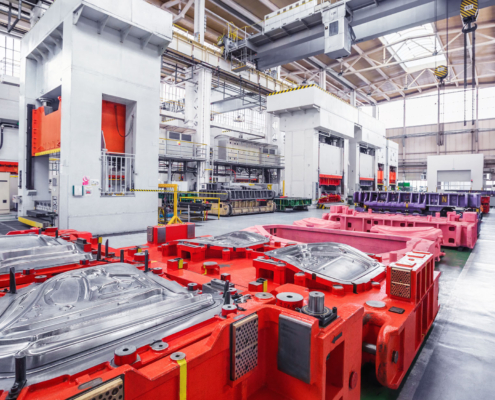

Step 1: Design and Engineering

The journey of metal stamping begins with the design and engineering phase. This is where the blueprint for the final product is developed. Designers and engineers work collaboratively to create detailed drawings and CAD (Computer-Aided Design) models, considering factors like material selection, tolerances, and the intended application of the part.

Material Selection

The choice of material is crucial as it impacts the performance and cost of the final product. Factors like strength, corrosion resistance, and formability are considered when selecting materials such as steel, aluminum, brass, or copper.

Tolerances and Specifications

The design must account for the required tolerances and specifications. This ensures that the stamped parts meet the exact dimensions and quality standards.

Tool Design

Tooling, or die design, is integral to the design process. Tool and die designers create molds, dies, and other tooling components that will shape the metal into the desired form during stamping.

Feasibility Analysis:

Engineers conduct feasibility studies to evaluate whether the design is manufacturable and cost-effective. Adjustments are made as needed to ensure the part can be stamped successfully.

Step 2: Tooling

Once the design is finalized, the focus shifts to tooling. Tooling is the key to achieving precise and consistent results in metal stamping.

Die Production

The dies, consisting of upper and lower sections, are manufactured using hardened steel. The upper die is attached to the press, while the lower die is mounted to the press bed.

Tool Assembly

The upper and lower dies are assembled into the press, with precision alignment to ensure accurate stamping.

Prototyping and Testing

Before full-scale production, prototypes are commonly created to test the tooling setup and fine-tune the process. This ensures that the final parts will meet the design specifications.

Step 3: Stamping

The four-slide metal stamping process derives its name from the specialized four-slide machine used in the production process. A four-slide machine is designed to perform intricate stamping operations with remarkable precision. Here are the key steps in the four-slide stamping process:

Material Feeding

A coil or sheet of metal is fed into the four-slide machine. The machine’s feeding system ensures the material is positioned correctly for stamping.

Bending and Forming

The four-slide machine uses multiple slides and tooling to bend, shape, and form the metal according to the design specifications. The ability to manipulate the metal from various angles allows for complex shapes to be created.

Cutting and Piercing

The machine can also cut and pierce the material to create holes, slots, or other openings in the stamped part. This is done with precision and consistency.

Secondary Operations

Depending on the specific part design, secondary operations such as threading, embossing, or crimping may be performed during the stamping process.

Quality Control

Quality control measures are in place throughout the stamping process to ensure that each part meets the desired specifications. This may include in-line inspections or the use of automated inspection equipment.

Material Removal

Once the metal has been stamped, any excess material or burrs are removed to achieve a smooth and clean finish.

Step 4: Finishing and Quality Assurance

After the metal stamping process is complete, several steps follow to prepare the parts for their intended use:

Deburring

Removing any sharp edges or burrs that may be present on the stamped parts to ensure safety and functionality.

Cleaning

Parts may be cleaned to remove contaminants or residues left from stamping.

Surface Treatment

Depending on the part’s requirements, surface treatments like plating, painting, or coating may be applied for corrosion resistance or aesthetics.

Assembly

Sometimes, multiple stamped parts may be assembled to create a more complex component or product.

Quality Assurance

Final inspections are conducted to ensure that the parts meet the required quality standards. This includes checking dimensions, tolerances, and surface finishes.

Packaging and Shipping

Once the parts have passed all quality checks, they are packaged according to customer specifications and prepared for shipping.

Advantages of Four-Slide Metal Stamping

The four-slide metal stamping process offers several advantages that make it a popular choice in various industries:

Complex Shapes

The ability to manipulate the material from multiple angles allows for the creation of intricate and complex shapes.

High Precision

The four-slide machine provides tight tolerances and consistent results, ensuring that parts meet exact specifications.

Cost-Effective

The efficiency of the process, combined with reduced material waste, makes four-slide stamping a cost-effective manufacturing method.

High Production Rates

Four-slide machines can operate at high speeds, making them suitable for large production runs.

Versatility

The process can handle a wide range of materials, including metals and alloys, making it versatile for different applications.

Four Slide Machines That Build Precise Components for Multiple Industries

Franklin Fastener has experience creating custom components that meet the needs of multiple industries. Learn more about who we serve.

Industries We Serve

Applications of Four-Slide Metal Stamping

The versatility and precision of the four-slide metal stamping process make it ideal for a wide range of applications across various industries:

  • Electronics: Four-slide stamping is commonly used to produce connectors, contact springs, and other electronic components.
  • Automotive: Parts like brackets, clips, and connectors are manufactured using four-slide stamping in the automotive industry.
  • Medical devices: Medical device manufacturers use four-slide stamping to produce components like surgical instruments, sensor housings, and implantable devices.
  • Aerospace: In aerospace applications, the process is employed to create small, intricate parts used in aircraft and spacecraft.
  • Consumer goods: Items such as zippers, buckles, and small hardware components are often produced using four-slide metal stamping.
  • Appliances: Components for household appliances, like hinges, latches, and brackets, are manufactured using this process.

Franklin Fastener’s Four-Slide Machine Capabilities

Precisely built components are vital for equipment manufacturing processes. As a leading provider of engineered assemblies,  Franklin Fastener creates custom parts with our four-slide machines that offer the following capabilities:

  • Parts produced from strip or wire
  • Feed length up to 20 1/2 inches
  • Stock width up to 3.38 inches
  • Material thickness up to 1/8 inch
  • Wire diameter up to 1/4 inch
  • Nilson Fourslide: 700I, SF2, SF3, SF4T
  • Bihler multi slides: RM35-GRM80
  • Stock tooling for standard parts
  • Secondary operations (plating, painting, and coating)
  • Support capabilities include welding, technical assembly, and kitting.
  • In-house tooling design and die build
  • Radial and linear parts forming capabilities

Contact us today to see what our four-slide machines can do for your business.

Share This Post

  • Share on Facebook
  • Share on X
  • Share on WhatsApp
  • Share on Pinterest
  • Share on LinkedIn
  • Share on Tumblr
  • Share on Vk
  • Share on Reddit
  • Share by Mail

More Like This

metal stamping machines in warehouse

Four Slide vs Traditional Power Press: Which Is Better?

Uncategorized
Learn the difference between four slide vs. traditional power press stamping and which is suitable for your products.
June 30, 2023
https://franklinfastener.com/wp-content/uploads/2023/06/metal-stamping-machines-in-warehouse.jpg 1250 2000 Abstrakt Marketing /wp-content/uploads/2022/12/fastener-logo1-01.png Abstrakt Marketing2023-06-30 10:29:532026-05-17 10:50:19Four Slide vs Traditional Power Press: Which Is Better?
metal stamping parts in a large pile

Our Metal Forming Glossary

Uncategorized
Our metal-forming glossary provides definitions for common words and phrases for the metal fabrication industry.
June 30, 2023
https://franklinfastener.com/wp-content/uploads/2023/06/metal-stamping-parts-in-a-large-pile.jpg 1250 2000 Abstrakt Marketing /wp-content/uploads/2022/12/fastener-logo1-01.png Abstrakt Marketing2023-06-30 10:01:102026-05-17 10:50:19Our Metal Forming Glossary

Categories

  • Clamps
  • Competencies
  • Custom Products
  • Engineering
  • Fastening
  • Heavy Truck
  • Metal Stamping
  • Products
  • Uncategorized
  • Welding and Assembly
  • Wire Forming

Contact Us

"*" indicates required fields

This field is for validation purposes and should be left unchanged.

About Us

Franklin Fastener is an industry-leading provider of engineered metal products. From concept to completion, our experts provide our clients with the highest service levels.

What We Do

Competencies

Engineering

Products

Industries

Documentation

Terms of Sale

Terms of Purchase

Catalog

Supplier Requirements

Contact Us

12701 Beech Daly, Redford Charter Twp, MI 48239

313-537-8900

websales@franklinfastener.com

Accreditations

Website by Abstrakt Marketing Group © 2023
  • Sitemap
  • Privacy Policy
Link to: Improve Component Performance With These Metal Polishing Techniques Link to: Improve Component Performance With These Metal Polishing Techniques Improve Component Performance With These Metal Polishing Techniques Link to: The Hidden Engineering Between Industrial Clips and Clamps Link to: The Hidden Engineering Between Industrial Clips and Clamps The Hidden Engineering Between Industrial Clips and Clamps
Scroll to top Scroll to top Scroll to top

This site uses cookies. By continuing to browse the site, you are agreeing to our use of cookies.

AcceptLearn more

Cookie and Privacy Settings


How we use cookies

We may request cookies to be set on your device. We use cookies to let us know when you visit our websites, how you interact with us, to enrich your user experience, and to customize your relationship with our website.

Click on the different category headings to find out more. You can also change some of your preferences. Note that blocking some types of cookies may impact your experience on our websites and the services we are able to offer.

Essential Website Cookies

These cookies are strictly necessary to provide you with services available through our website and to use some of its features.

Because these cookies are strictly necessary to deliver the website, refusing them will have impact how our site functions. You always can block or delete cookies by changing your browser settings and force blocking all cookies on this website. But this will always prompt you to accept/refuse cookies when revisiting our site.

We fully respect if you want to refuse cookies but to avoid asking you again and again kindly allow us to store a cookie for that. You are free to opt out any time or opt in for other cookies to get a better experience. If you refuse cookies we will remove all set cookies in our domain.

We provide you with a list of stored cookies on your computer in our domain so you can check what we stored. Due to security reasons we are not able to show or modify cookies from other domains. You can check these in your browser security settings.

Other external services

We also use different external services like Google Webfonts, Google Maps, and external Video providers. Since these providers may collect personal data like your IP address we allow you to block them here. Please be aware that this might heavily reduce the functionality and appearance of our site. Changes will take effect once you reload the page.

Google Webfont Settings:

Google Map Settings:

Google reCaptcha Settings:

Vimeo and Youtube video embeds:

Accept settingsHide notification only